Netherlands and Germany agree to boost cross-border rail
Staatssecretaris (junior minister) Annet Bertram and German transport minister Steffen Bilger signed a joint declaration in Berlin to run more and faster international trains between the two countries.
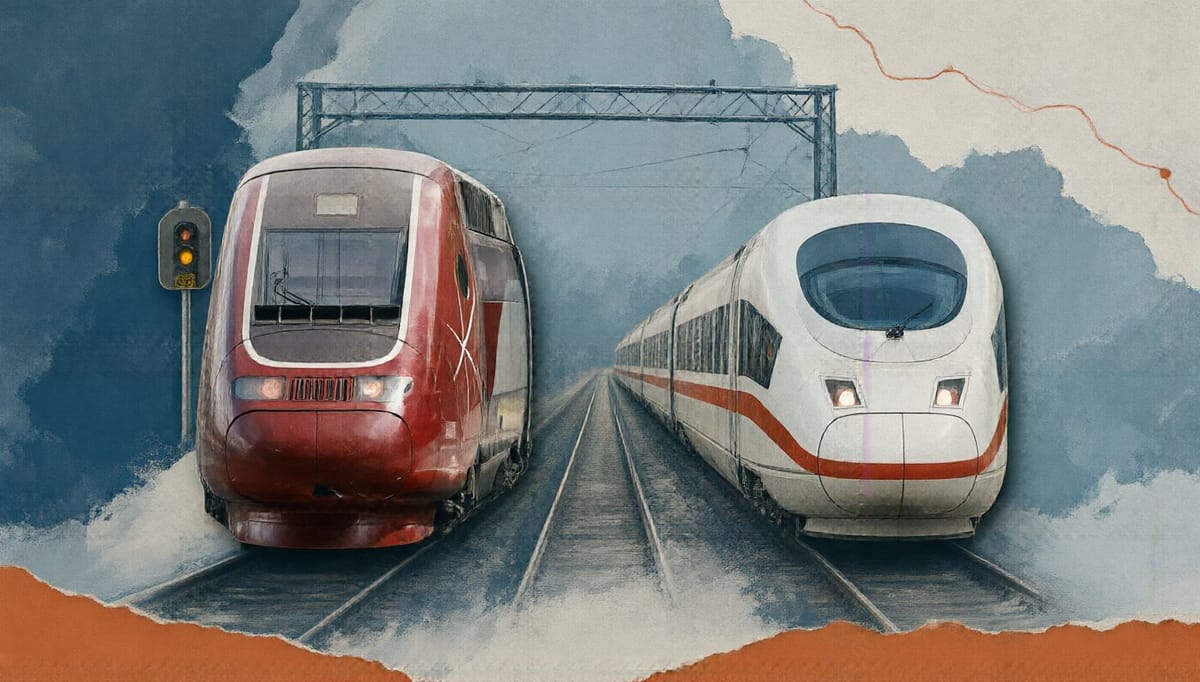
The goal: Both countries want more passenger trains and shorter travel times, especially on Amsterdam-Hamburg, Amsterdam-Berlin and Amsterdam-Frankfurt. These routes should also connect onward to Copenhagen, Warsaw, Prague, Basel and Vienna.
By the numbers:
- Roughly twice as many fast trains run daily to Paris as to Berlin, according to the sources.
- Bertram said Amsterdam to Paris takes 3.5 hours (500 kilometres). Berlin takes almost 7 hours (660 kilometres).
- NS and Deutsche Bahn run only four direct trains from Amsterdam to Berlin, according to NRC-style reporting in one source.
- About 45,000 freight trains a year cross the border at Zevenaar, Venlo and Bad Bentheim.
New operators: The countries want to make it easier for new rail operators to enter the international market, to create more competition. One source says GoVolta runs daily to Berlin and European Sleeper runs a night train three times a week.
Local line and disruption:
- Next month, a local train starts between Coevorden and Bad Bentheim. Passenger service on that line returns after 87 years.
- Next spring, all direct trains to Berlin are cancelled for three months because of long-term works, according to one source.
- New train sets have cut seats per train by a quarter, which pushes up ticket prices, that source says.
Freight and technical work:
- Four cross-border projects are on the list, including more capacity on the Emmerich-Oberhausen stretch, the German link to the Betuweroute freight line.
- The other three are Venlo-Kaldenkirchen-Viersen, the Bad Bentheim/Oldenzaal border crossing and Bremen-Oldenburg-Groningen-Amsterdam.
- The countries will cooperate on the European ERTMS train safety system and on 740-metre trains, which are also needed to move tanks.
What Bertram said: She said frequency cannot simply be raised. She also said Germany's infrastructure shortfalls are huge, and no firm end date is in sight for the Betuweroute link. She hopes for several trains per hour to Frankfurt or Berlin in 10 to 15 years. She did not travel to Berlin by train because of large diversions.
What is next: Working groups, including ProRail and its German counterpart, will map the bottlenecks. The ministers will meet every year.