Dutch Customs to tighten checks on smuggling dinghies
Dutch Customs (Douane) will check imports of large rubber boats used to smuggle people across the Channel more strictly, the Douane told Nieuwsuur.
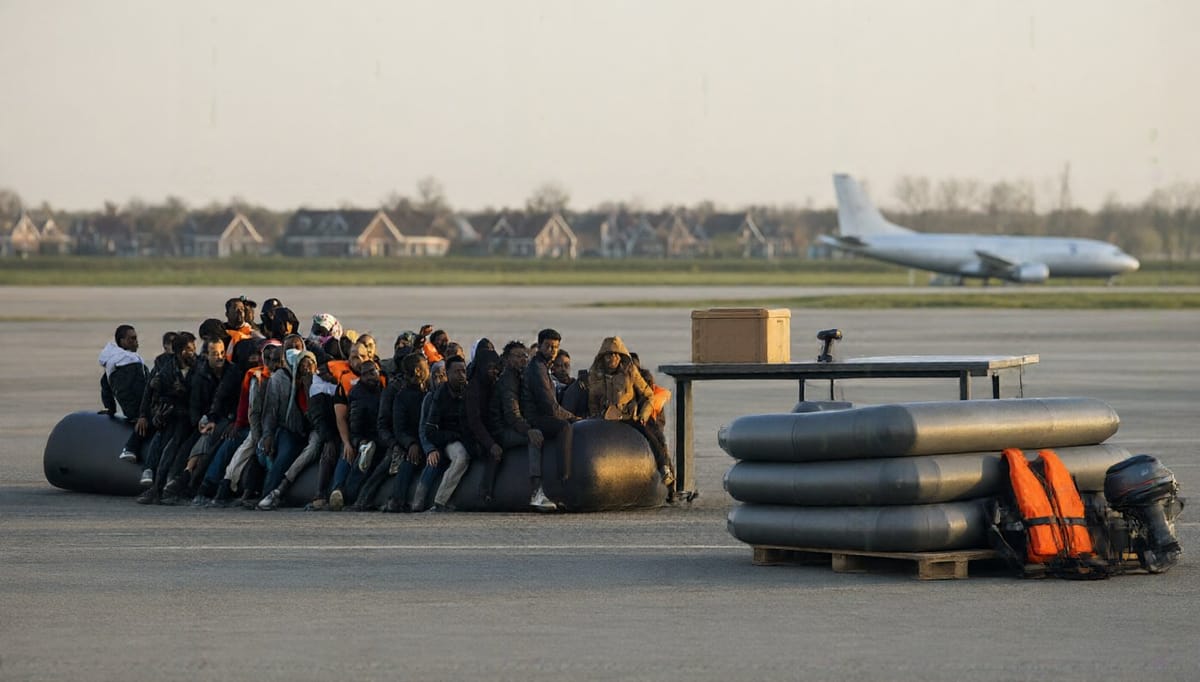
Driving the news: In recent weeks, rubber boats have arrived in the Netherlands more often on cargo planes from Turkey.
- The Koninklijke Marechaussee (military police) recently intercepted two shipments. One arrived by air, another overland.
- British Customs intercepted a shipment of 25 rubber boats two weeks ago. It came from Turkey and was due to reach the Netherlands via a British airport.
- Erwin, an intelligence officer at the Marechaussee, said this is new and the force must respond.
Smuggling packages: The Openbaar Ministerie (public prosecution service) says criminal networks in the Netherlands assemble "smuggling packages" to order. Petra Hoekstra, national public prosecutor for migration crime, said they include boats, fuel and life jackets, and are delivered to people in France or Belgium. She said the packages are worth €10,000 to €20,000 each.
Almere case: Last year the Marechaussee arrested five men in Almere after an investigation. Two were caught in the act at a car-sharing car park along the A1, with deflated boats, life jackets and engines in their car.
What changes: The Douane does not yet check specifically for these boats from China. A ministry spokesperson said the aim is for risk-based checks to be possible this year. The Inspectie Leefomgeving & Transport (ILT) said it is talking with the Douane to get import data. It then plans to set up border checks with the Douane.
By the numbers:
- Channel crossings in 2026 are about 42% lower than last year, but deaths are roughly the same.
- About 41,500 migrants tried to cross in 2025. This year's provisional figure is slightly under half of that.
- AFP counted at least 29 deaths in 2025 and at least 22 so far in 2026.
- Europol calculated that smugglers earned about €100,000 per boat last year after costs.
Context: According to justice authorities, the boats come from China and travel via Turkey to Western Europe. They were previously stored mainly in Germany, where involvement in such smuggling was long not punishable. That is now punishable, and the Openbaar Ministerie thinks criminals are therefore shifting to the Netherlands. Hoekstra said the boats are "completely unsuitable" and that much of the money is not recovered.